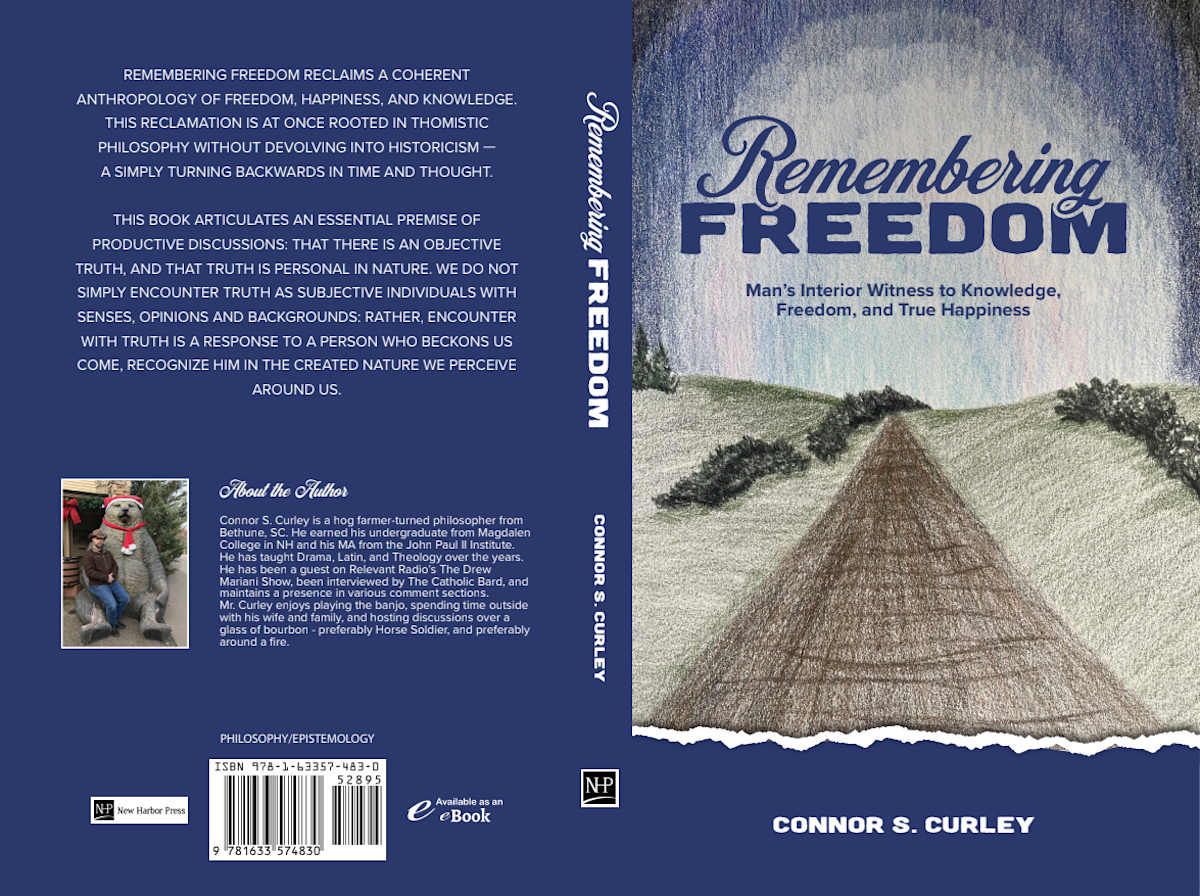
It is a surreal experience to search for your own name and see something you worked hard and passionately on come up. Such was the case for me when I first looked up Remembering Freedom and its availability. The book is available for pre-order now!
The sport of public debate is back. Look everywhere around you: conversation is beginning to take place again. From the “prove me wrong” of Steven Crowder to the college campaigns of the late Charlie Kirk to the return of the street preachers, we see the public once again becoming enamored of real discussion. Debate is back; human nature is ready to be human once again, joining together for discourse, discussion, and constructive critiques of the philosophical inheritance we have been handed - and what reality is actually made of so that we can act within and upon it as good stewards.
As exciting as it is to see discussions happening again, we still have the ills of relativism to contend with. Too often, the worldviews and fundamental beliefs of the modern human are too far removed from our own to have meaningful discussions, and who is to say who is right? How are we to communicate and have discussions when everything is boiled down to mere point of view? Or how are we to discuss human flourishing when happiness is considered the fulfillment of fleeting pleasure? And how are we to respond when our cries to outlaw evil are met with protestations that we are inhibiting personal freedom? The ultimate question for the American - indeed, for every human today - is: how is it that I am free, how do I defend eradicating evil as still upholding individual freedom, and - perhaps most damnably - how is it that I can know I am right in these matters?
If you find yourself met with these challenges in the crazy modern dialogue, you are not alone. And this book is just for you.
Remembering Freedom reclaims a coherent anthropology of Freedom, Happiness, and Knowledge. This reclamation is at once rooted in Thomistic philosophy without devolving into mere historicism - a simple turning backwards in time and thought. This book articulates an essential premise of productive discussions: that there is an objective truth, and that Truth is Personal in nature. We do not simply encounter truth as subjective individuals with senses, opinions, and personal backgrounds: rather, encounter with truth is a response to a Person Who beckons us come, recognize Him in the created nature we perceive around us.
Remembering Freedom is unique on the public stage in that it is rooted in classical philosophical premises, while at the same time not falling prey to historicism as the only way of reclaiming coherency. It offers a synthesis of complex intellectual traditions in a way that is timely, coherent, and pastorally relevant, giving clarity through integrating traditional ideas to a coherent worldview - something sorely lacking in modern discourse. This book is designed to be at once engaging and practical: though some technical distinctions like those between anamnesis, synderesis, and conscience are present in the book, each one is accompanied by practical story aimed at illustrating what this more “abstract” thing looks like here in the real world - and offers a synthesis as to why this distinction matters, and how we are to apply it.
Knowledge is not an abstract or merely scientific in its composition, nor is freedom a license to do what I wish so long as I do not harm anyone else. These positions are hard to hold and defend here in the year 2026; but without the ability to articulate these premises, we are left with that false humility that causes us to end each apology of our Faith with the dreaded “I don’t know, though,” just in case we’re wrong - or, worse yet, “you do you.” If you are looking to enter into discussions, if you find yourself wondering how on earth we got to the point we are at now, or if you find yourself trying to reconcile the American identity of freedom with something more conservative than libertarianism, this book is for you.
Welcome to the discussion.